The Real Range Kit
The HoverboardRadix kit for how far your hoverboard, e-scooter or electric unicycle really goes, and gets you back, on the pack you have today
HoverboardRadix's Range Calculator turns a battery into kilometers, and it is right for what it assumes: a new pack, the consumption you typed, and a ride that ends at zero. Our Battery Cycle Life planner says the same pack fades with every charge, and our Charge Time estimate works from empty. None of them knows the leg home, where to turn around, or when tonight's charge will finish. The Real Range Kit puts them together. In its worked example, a year-old 36 V, 7.8 Ah scooter holds 251.6 Wh, not 280.8, and plans on 201.3 with a 20% reserve. One 8 km calibration loop gives the rider's own 15.72 Wh/km; with a backpack and a climb home he turns at 5.64 km, where half of the calculator's plan-on figure would have left him empty 0.45 km from home. His commute's recharge is 2 h 56 min plus a measured finish, done by 22:06 while he is still up, and at the worn end of the pack's life the commute needs 223 Wh, so a bigger board is not needed yet. Every worked figure is an example you replace with your own ride. The kit asks for boards certified to UL 2272, charging only while someone is awake and nearby, never overnight, and never suggests opening a battery, raising a speed limit or changing firmware. You get a 25-page printable PDF with seven steps, a calibration log, a trip card, a charge log, a rider check, reference tables, the safety floor and a quickstart, plus a personalised sheet worked out from the numbers you entered in our calculators.
Look inside
Two full pages from the kit, exactly as printed. Click either to read it at full size before you decide.
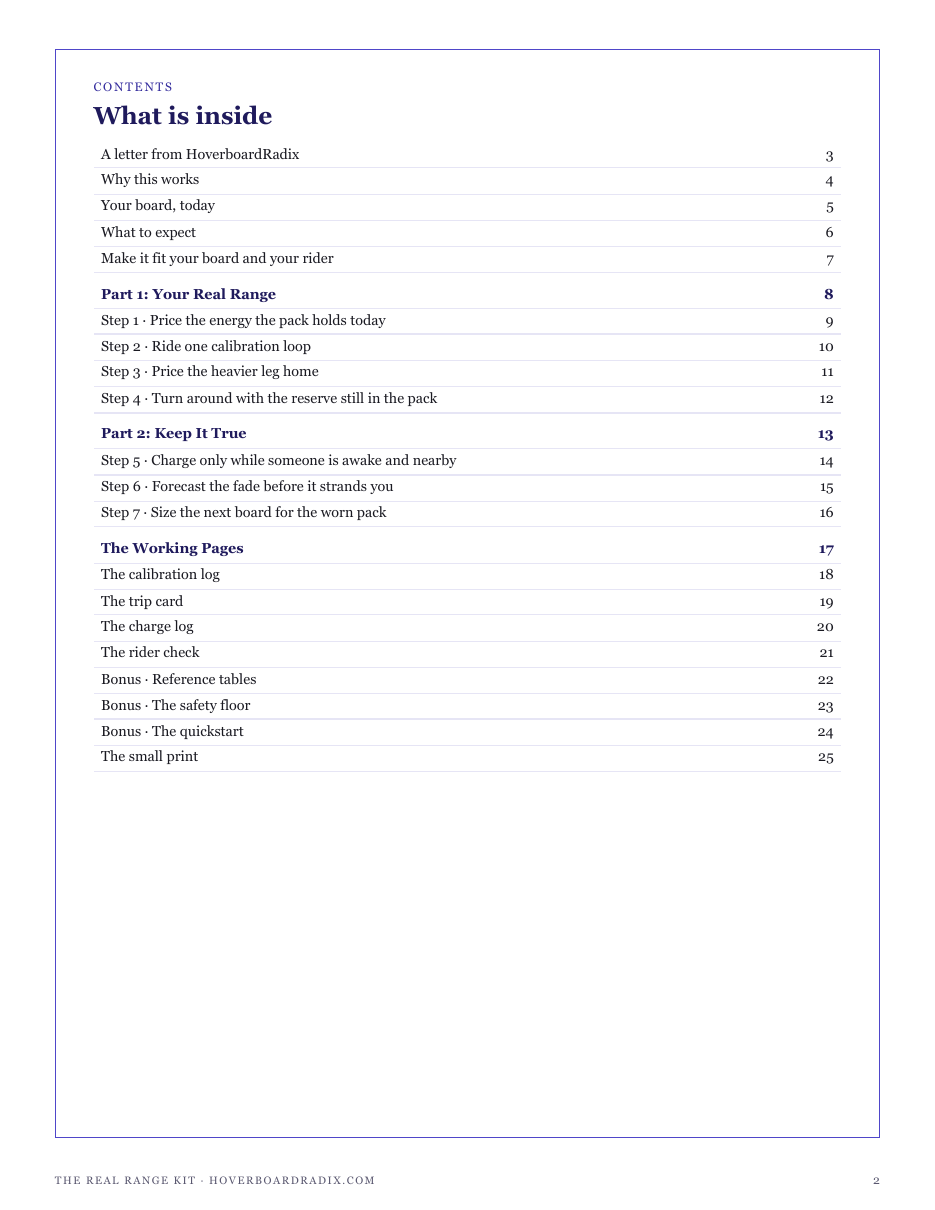
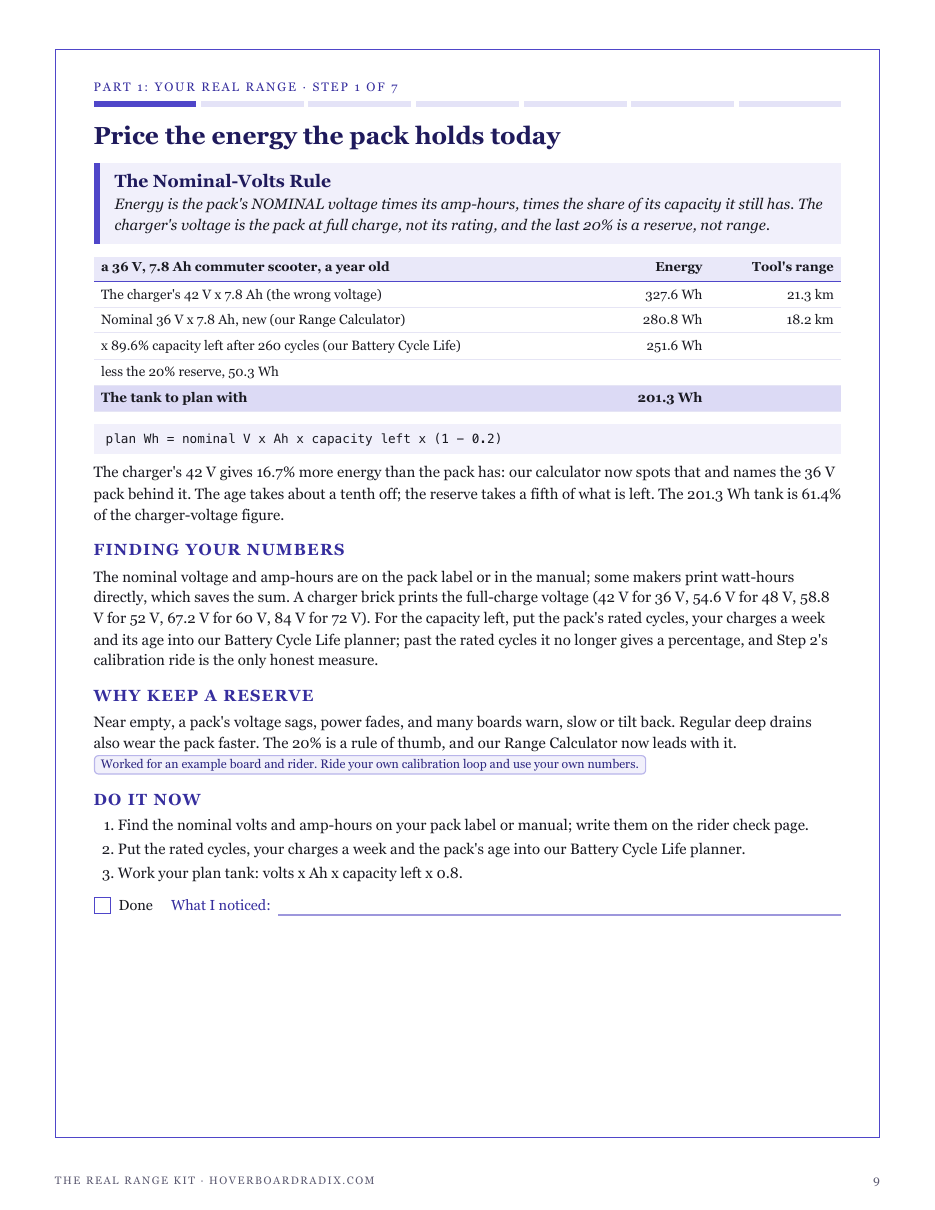
What is in it
- The real tank: nominal volts (not the charger's), capacity left and a 20% reserve
- The calibration ride: your own Wh/km from one known loop and the gauge
- The heavier leg: your load and the climb home through the site's weight and terrain model
- The turnaround: where to turn, and the gauge reading to turn by, with the reserve still in the pack
- The attended charge: tonight's recharge from the gauge you arrive with, finished while someone is awake
- The fade forecast: your turnaround through the rated cycles, and when a replacement is really due
- The right-size board: pack watt-hours for the worn end, the 80% weight line and UL 2272 first
- Working pages: a calibration log, a trip card, a charge log and a rider check for every rider
- Reference tables and the safety floor: plan-on and turnaround km by pack size, charger vs nominal voltage
- A quickstart, and a personalised sheet worked from the numbers you entered
- ✓ 25 printable pages
- ✓ 10 sections, worksheets and templates
- ✓ A second PDF worked out from the numbers you enter
- ✓ No account needed, just an email address
- ✓ Instant download; link valid 7 days
Price includes any taxes. Sold by GrabURL, who handle checkout and support. The charge appears on your statement as GrabURL.
The kit picks up where the free Range Calculatorleaves off. The calculator prices a new pack at its nominal energy on the flat; the kit prices the energy your pack holds today, measures your own consumption on one calibration loop, prices the heavier leg home, sets a turnaround with a reserve still in the pack, works out how long tonight’s recharge takes so it can be done while someone is awake and nearby, forecasts the fade, and sizes the next board for the worn pack. It never suggests opening or modifying a battery, raising a speed limit or changing firmware, and it asks for boards certified to UL 2272. The worked figures are examples; your own ride replaces them.