Hoverboard vs. Electric Scooter: Which Is Right for You?
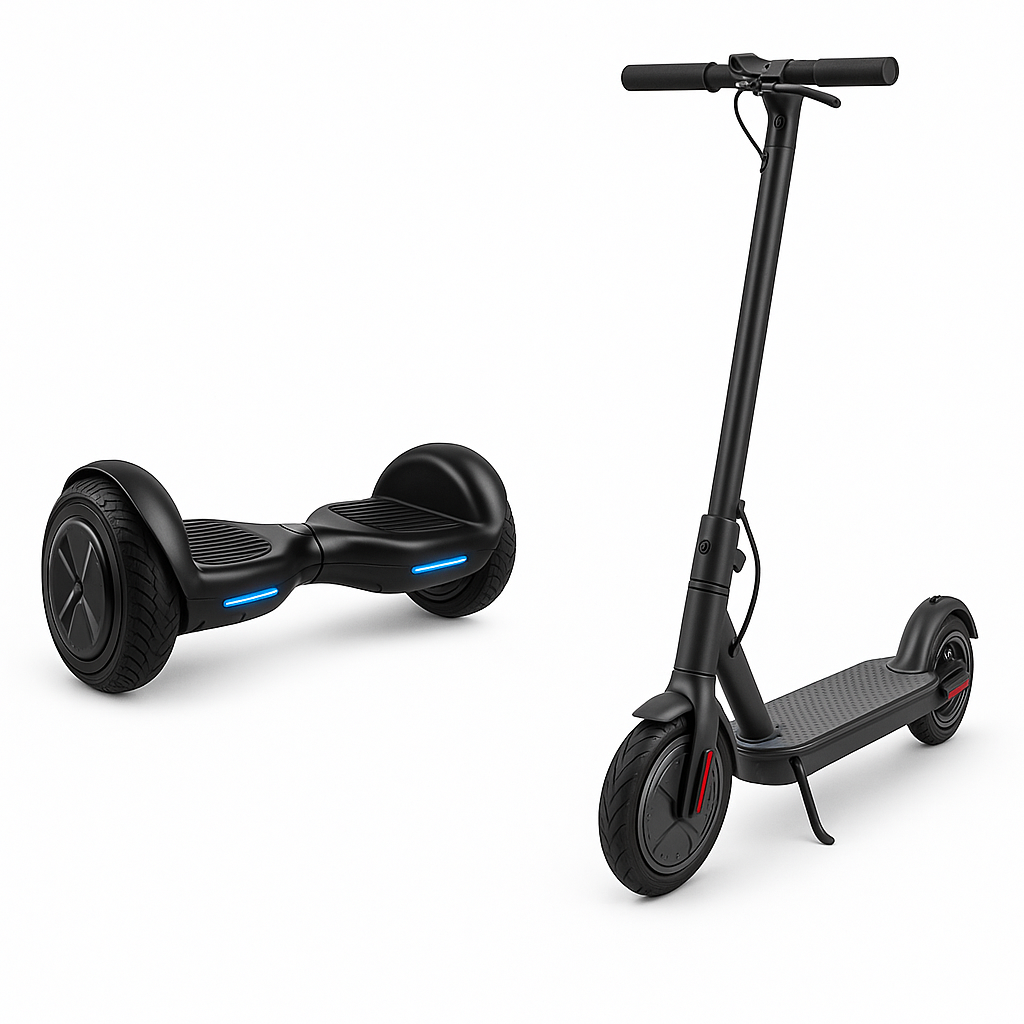
If you’re looking for a fun and convenient way to get around, you’ve probably considered hoverboards and electric scooters. But hoverboard vs. electric scooter – which is better? The answer isn’t one-size-fits-all; it depends on what you value most. In this comparison, we’ll break down key factors like safety, ease of use, portability, speed, range, and even the “fun factor” to see how hoverboards stack up against e-scooters. By the end, you’ll have a clearer idea of which personal transportation device suits your lifestyle and needs.
Both hoverboards (self-balancing scooters) and electric kick scooters have become popular gadgets in recent years, offering a way to cruise without pedaling or walking. Let’s dive into the pros and cons of each category:
1. Ease of Learning and Use
Hoverboard: Hoverboards have a bit of a learning curve. Balancing on two wheels without handlebars can feel tricky at first. Beginners typically need anywhere from a few minutes to a few hours to get comfortable. You have to learn to trust the self-balancing mechanism and use subtle shifts of your feet and body to control movement. Stepping on/off is one of the hardest parts initially. Once you learn, it becomes intuitive, but not everyone picks it up instantly – some practice in an open area is needed.
- Upside: Younger folks and kids often learn quickly and find it second nature after a while, almost like learning to ride a bike in terms of balance learning. It can actually improve your sense of balance overall.
- Downside: Some people (especially those less confident in their balance) may be scared off during the learning stage. There’s a risk of falling if you step on wrong or panic.
Electric Scooter: Electric scooters (with a handlebar, like the popular rental e-scooters in cities) are generally easier for most people to just hop on and go. If you’ve ever ridden a kick scooter as a kid, it’s very familiar. You have handlebars for stability, you typically start by kicking off, then the motor takes over. Balancing on an e-scooter is straightforward thanks to holding the handle.
- Upside: Very quick to learn – most can get it in a minute. Steering with handlebars is intuitive, and you have hand or foot brakes which people understand (versus learning to lean back on a hoverboard to brake).
- Downside: E-scooters still require some balance (it’s like a narrow platform you stand on) and caution, but the learning barrier is lower than a hoverboard’s. Really, if you can ride a bicycle or regular scooter, you can ride an e-scooter with little coaching.
Verdict: Electric scooters win for ease of use. They are more beginner-friendly. Hoverboards require a learning period and aren’t as immediately straightforward for most.
2. Safety and Stability
Hoverboard Safety: Hoverboards can be safe when used responsibly, but there are considerations:
- No Handle Support: Without handlebars, if you hit a bump or need to stop suddenly, you rely entirely on your balance. It’s easier to fall off compared to a scooter where you might have a chance to hold on.
- Lower Speeds: Hoverboards typically have lower top speeds (around 6-10 mph for most). Lower speed can mean less severe injuries in falls if they occur, and you’re closer to the ground.
- Terrain Risks: Small wheels (6-8 inch) mean hazards like cracks or sticks can stop the board suddenly and cause a tumble. Off-road hoverboards mitigate this with bigger wheels, but on a standard hoverboard, you have to be very mindful of terrain.
- Protective Gear: It’s highly recommended to wear at least a helmet, and often wrist guards, because falling backward or forward can lead to wrist impact or head impact.
Electric Scooter Safety:
- Handlebars and Brake: Scooters offer more control – you have a handle to stabilize yourself and typically a brake to slow down quickly. This can prevent some accidents or help recover from a wobble.
- Higher Speeds: Many e-scooters go 15-20 mph or moreanidjarlevine.com. At those speeds, if you crash, it can be more dangerous. Also, riders might take them on the road or bike lanes, introducing interaction with traffic, which carries its own risks.
- Larger Wheels: Most scooters have larger diameter wheels than hoverboards, and sometimes suspension, which handle bumps better, reducing the chance of getting thrown by a minor obstacle.
- Visibility: On a scooter, you’re a bit taller and maybe more visible to pedestrians and cars. Some scooters also have lights/reflectors for night use. Hoverboard riders are lower and might be less noticed.
- Protective Gear: Also strongly recommended (helmet at a minimum). Because scooters can go faster, helmet use is arguably even more critical.
Verdict: Electric scooters tend to be safer in terms of stability and hazard handling (handlebars, bigger wheels, brakes), but their higher speeds and use on roads can introduce other risks. Hoverboards are safe for slow, controlled environments but are easier to fall off if a balance error occurs. So, for the average person on varied terrain, scooters provide a safety edge.
3. Portability and Convenience
Hoverboard Portability: Hoverboards are relatively compact – basically a 2-foot wide board you can carry. They typically weigh between 20-30 lbs (9-13 kg), depending on model.
- Carrying: They have no handle or stem, so you either carry it in your arms or use a carrying bag. 25 lbs isn’t super heavy, but it’s awkward to carry for long because of the shape. Some hoverboards come with a carry handle built into the center, which helps a bit.
- Storage: They can fit in a large backpack or duffel if needed (especially the smaller 6.5” wheel ones). They easily fit in car trunks, under desks, etc. So they’re fairly easy to stow away when not riding.
- Short Distance Tool: Hoverboards are great for that “last mile” commute in theory, but carrying it into a store or onto a bus can be a bit clunky due to weight with no easy handle. Still, it’s doable.
Electric Scooter Portability: Scooters are larger in one dimension (length) due to the handlebar stem, but many have folding designs.
- Folding: Most commuter e-scooters fold down – the stem folds onto the deck, making a long, thin package. When folded, you can carry a scooter by the stem like a handle, or roll it on its wheels while folded (some designs allow that).
- Weight: E-scooters vary widely in weight. Lightweight models can be around 25-30 lbs (similar to hoverboards), but high-performance ones with big batteries can be 40-50+ lbs. So portability depends on model – a basic Xiaomi or Segway-Ninebot scooter ~27 lbs is decently portable; a high-end fast scooter at 50 lbs is much less so.
- Storage: A folded scooter can slide under a desk or into a trunk as well, but takes a bit more floor length. You can’t really put it in a backpack obviously.
- Carrying: Scooters have an advantage that you can roll them by one wheel often, like a dolly, if not completely folded. But carrying up stairs or onto transit is a consideration – you have to lug it like a awkward long object.
Verdict: Tie or depends on use-case. Hoverboards are smaller and maybe easier to tuck away, but carrying them lacks an easy handle. Scooters often have a built-in handle (the stem) and can fold, making them easier to walk with, but they are longer and some are heavier. If you need to carry your device frequently (up stairs, on buses), a light folding scooter might be more convenient than a hoverboard that you have to bear-hug. For just storing at home or in an office, hoverboard’s compactness is nice.
4. Speed and Range
Hoverboard Performance:
- Speed: Typically hoverboards top out around 6-10 mph (10-16 km/h). Some off-road or advanced ones might reach 12 mph. The limited speed is partly for safety (balance-wise, above that it gets sketchy)eridehero.com. This is fine for short distances or fun, but for longer commutes it’s not very fast.
- Range: Many hoverboards get about 5-7 miles (8-11 km) per charge on average modelseridehero.com. Some with bigger batteries advertise up to ~9-12 miles. So they are usually good for maybe an hour or two of casual riding. Enough for fun and short trips, but not for extensive travel without recharging.
- Use Case: Hoverboards are ideal for short hops – around campus, around the neighborhood, indoor big spaces (some people use them in warehouses or large office complexes). For anything beyond a few miles, you’d be pushing their limits.
Electric Scooter Performance:
- Speed: Scooters typically are faster. Most entry-level commuter scooters go about 15 mph (25 km/h), with some up to ~18 mph. High performance ones can hit 25-30+ mph, though those are pricier and more like light motor vehicles. Many cities even cap rental e-scooters at ~15 mph for safetyhoverboardlaws.com.
- Range: Scooters tend to have bigger batteries, thus longer range. Common models get anywhere from 9-15 miles (15-25 km) on a charge; better ones 20-30 miles; premium can go 40+ miles. So for commuting or touring around town, an e-scooter can take you much farther.
- Use Case: They can replace a bicycle or car for short city commutes realistically. You can zip across town at a decent pace. Hoverboards cannot really replace a commute vehicle unless it’s very short and you’re okay with the slower pace.
Verdict: Electric scooters clearly win on speed and range. They are built to cover distance and go faster. Hoverboards are more of a short-distance novelty/last-mile device in terms of performance.
5. Maneuverability and Fun Factor
Hoverboard Fun:
- Maneuverability: Hoverboards can turn in place (zero-radius turning) by making one wheel go forward, the other backward. This is super maneuverable in tight spaces – you can spin around easily. They’re great for weaving around objects or even indoor use (some people hoverboard around their house for fun). The feeling of gliding sideways or spinning can be really entertaining.
- Tricks: You can do some tricks or skills on hoverboards (like spins, riding backwards, maybe some dance moves or low ramps). Also, attachments can turn them into hoverboard go-karts, which is another kind of fun.
- Unique Feel: Many find the feeling of a hoverboard very cool – it’s closer to “hovering” like the fictional idea, because you face forward and move without visible effort, which looks and feels futuristic.
Electric Scooter Fun:
- Maneuverability: Scooters have a larger turning radius due to the handlebar and wheelbase. You can’t turn in place; you need some space to loop around. Not as nimble in very tight quarters as a hoverboard.
- Thrill: However, scooters provide the thrill of speed. Going 15+ mph with wind in your face is fun in a different way, akin to biking or motor scootering. It feels more like transportation, but still enjoyable. Some scooters can handle small jumps or hopping off curbs if you’re skilled (though not recommended unless you know what you’re doing as it can damage cheap models).
- Tricks: There’s not much trick riding on typical e-scooters (they’re heavier and not built for stunts like non-electric kick scooters might be).
- Ease of Ride: Some find scooters more relaxing to ride because you’re not concentrating on balancing as much, so you can enjoy the scenery more at moderate speeds.
Verdict: Hoverboards might edge out scooters on the pure “fun/novelty” factor, especially for kids and casual play, thanks to their unique movement style and nimbleness. For someone who loves a bit more speed and an adrenaline rush, an e-scooter might be more fun. It’s subjective, but hoverboards have that cool self-balancing allure, whereas scooters are fun in a more conventional way (like a tiny electric bike).
6. Practicality (Real-world Use)
Hoverboard Practicality:
- Commute Integration: Hoverboards can work for very short commutes (like within a campus or from a parking lot to an office), but on sidewalks with cracks or on busy streets, they’re not the best choice. Many places don’t allow them on roads, and on sidewalks you must go slow and be cautious of pedestrians.
- Weather: Most hoverboards aren’t great in wet conditions. They sit low, and water can get into components. Also slick surfaces + hoverboard = not easy to balance. So they’re mostly fair-weather devices.
- Legal Restrictions: Some cities have restrictions on hoverboards in public (just like skateboards or other personal transporters). Always good to check local rules.
- Maintenance: Hoverboards have fewer mechanical parts than scooters (no chains or disc brakes usually), so maintenance is largely keeping it charged and maybe calibrating sensors occasionally. But if something electronic fails, repairs can be tricky.
Electric Scooter Practicality:
- Commute Integration: Scooters excel as commuter devices for urban areas. Many cities specifically accommodate them via bike lanes. They can handle city street imperfections better and can flow with bike traffic.
- Carrying Things: On a scooter, you could wear a backpack comfortably. On a hoverboard, having a heavy backpack can throw off balance potentially. Scooters you could also install a basket or hang a bag from the handle for small items (careful not to upset balance though).
- Weather: Still not ideal in heavy rain (electronics and slippery ground), but some scooters have at least basic water resistance (IP ratings). You’ll also likely have fenders for some splash protection. Still, caution needed if ground is wet, as braking distance increases and risk of slip exists.
- Legal: E-scooters often fall under similar regulations as bicycles or e-bikes in many places, meaning they’re legal on roads/bike lanes (with some speed limits). Hoverboards often fall into a gray area since they’re smaller and sometimes considered “toy” or banned from roads and only allowed on private property.
- Maintenance: Scooters have more mechanical components (brakes, folding mechanisms, tires to inflate or that can puncture). They may require a bit more upkeep (tightening brakes, checking tire pressure, etc.). But it’s usually minor.
Verdict: Electric scooters are more practical for everyday transport and errands. Hoverboards are practical within limited, controlled environments (like smooth campus, indoor venues, or home use), but not as versatile in real-world commuting scenarios.
7. Cost
While cost isn’t exactly a feature comparison, it’s a practical factor:
- Hoverboard Cost: You can find decent hoverboards in the range of $150-$300 for standard models. High-end or specialty ones (off-road, big brand, or with advanced features) might go $400-$700. In general, they’re a bit cheaper than quality e-scootersrazor.com.
- E-Scooter Cost: A lot of good commuter scooters range $300-$600. Premium high-speed long-range ones can be $700-$1500 or more. There are budget scooters around $200-$250, but they often have lower performance or durability. On average, scooters might run slightly more expensive because of more material (frame, larger battery, etc.).
- Value: If you just want something fun for the kids in the driveway, a hoverboard might be the more economical choice. If you want a commuting machine, investing in a scooter might make more sense for the added capability.
Final Considerations
Choosing between a hoverboard and an electric scooter comes down to what you prioritize:
- If you want a fun gadget for short distances, indoor/outdoor play, or a unique riding experience, a hoverboard might be better. It’s great for kids, teens, or anyone who wants that futuristic feel and doesn’t need to go far or fast. It also is very compact to store.
- If you need a practical commuter or a more versatile personal transport that can get you from A to B efficiently on city streets or campus paths, the scooter is likely the better option. It offers stability, speed, and range to be actually useful for transportation, not just recreation.
Many people end up owning both for different purposes. But if it’s your first purchase in this arena, think about where you will use it most. For cruising around the neighborhood or park for fun – both could do, but hoverboard is more novel. For anything involving mixing with traffic or traveling miles, scooter all the way.
Also consider the environment: If you mostly have smooth private areas or indoors (some offices or warehouses allow hoverboards), that favors hoverboard. If you have nice bike lanes or smooth sidewalks to use, scooter thrives there.
Conclusion
In the hoverboard vs. electric scooter debate, neither is universally “better” – it depends on your needs and what you find enjoyable.
- Hoverboards are cool, self-balancing marvels that are fantastic for short fun rides, showing off spins, and developing balance skills. They’re relatively portable and lower speed, which can be a plus for safety in controlled areas. They’re the choice for a lot of younger riders and those wanting that distinctive ride feel.
- Electric scooters are more like a practical tool – still fun, but with a focus on getting you places. They’re easier for most to ride with confidence, handle a variety of terrains better, and can cover ground quickly. Commuters and adults often lean towards scooters for their utility and comfort.
So, ask yourself: Where and how do I plan to ride? Once you answer that, the choice often becomes clear.
If you’re leaning toward hoverboards but concerned about safety or learning, check out our Beginner’s Guide: How to Ride a Hoverboard Safely to boost your confidence. If you’re leaning toward scooters, make sure to familiarize yourself with local regulations and always ride courteously.
Whichever you choose, you’re in for a good time – personal electric transporters put a smile on your face and make any short journey more enjoyable. Stay safe and happy riding!