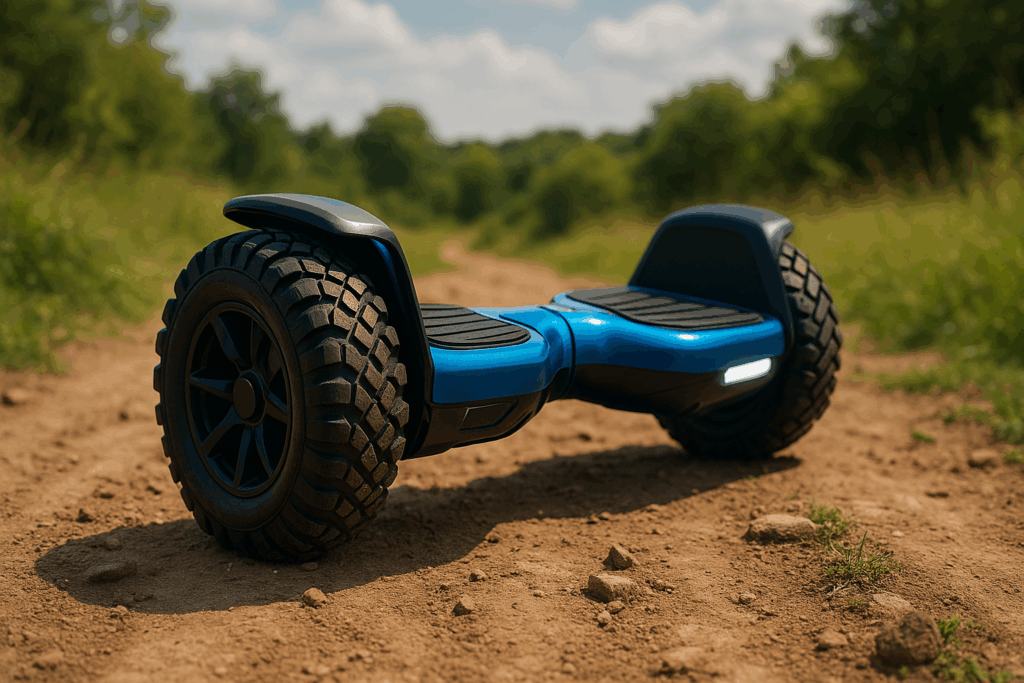
Hoverboards aren’t just for smooth sidewalks anymore – off-road hoverboards (also known as all-terrain hoverboards) have opened up a whole new world of riding possibilities. These beefed-up hoverboards come equipped with rugged tires, stronger motors, and durable builds, allowing riders to venture beyond pavement onto grass, dirt trails, gravel, and more. In this article, we’ll explore the key features of off-road hoverboards and some cool ways you can use them. If you love adventure and want a hoverboard that can keep up, read on to see what off-road models have to offer.
From bigger wheels and better traction to where you can ride (imagine cruising on the beach or through a park trail), we’ll break down everything you need to know about off-road hoverboards and help you decide if one is right for your next hoverboarding experience.
Key Features of Off-Road Hoverboards
What makes a hoverboard “off-road” capable? Here are the standout features to look for:
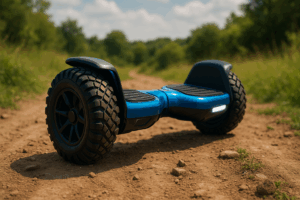
- Larger, All-Terrain Tires: Off-road hoverboards typically have larger wheel diameters – commonly 8.5 inches, and some up to 10 inches or moreeridehero.comeridehero.com. These wheels often have pneumatic (air-filled) tires or deep tread solid rubber tires. The chunky tread provides grip on loose surfaces like dirt, sand, or grass, and the larger diameter helps roll over bumps and small obstacles easily.
- Powerful Motors: To drive those bigger wheels and handle uneven terrain, off-road models usually pack more motor power. Many have dual 350W or 400W motors (700W–800W total) or highereridehero.comeridehero.com. This gives them the torque needed to climb inclines and not bog down off-road. More power also often means they can achieve slightly higher top speeds on flat ground.
- Durable Build and Frame: Off-road hoverboards are built tough. They have sturdy frames (often metal-reinforced) to withstand jolts. The chassis may be a bit taller to give better ground clearance. They often have water-resistant design (some level of splash or water protection) since off-roading might involve puddles or mud. They’ll also commonly feature fender flares or wheel covers to protect the rider from debris kicked up by the tires.
- Advanced Stabilization: The internal sensors and software on good off-road hoverboards are tuned for stability on uneven ground. They might have upgraded gyroscopes or improved algorithms that adjust balance more quickly when one wheel hits a bump and the other doesn’t. This helps keep the ride smooth even when the terrain isn’t.
- Higher Weight Capacity: All-terrain boards often support heavier weights (sometimes 250-300 lbs capacity)eridehero.com. Partly because adult riders wanting to off-road may be on the heavier side, and also the stronger build and motors can handle more load.
- Battery Life: Off-roading can use more power (because of friction and slope). Many off-road models come with high-capacity battery packs to ensure decent range even when riding on tougher terrain. It’s not uncommon to see ranges of 7-10 miles or moreeridehero.com, though of course it depends on usage.
- Extras: Some have built-in Bluetooth speakers and app connectivity like standard hoverboards, but the focus is more on performance. You might see additional features like different ride modes (beginner to advanced, or a “child mode” vs “adult mode” for power limiting), and strong LED headlights to illuminate trails in lower light.
In short, off-road hoverboards take the basic concept of a hoverboard and bulk it up into a more robust personal ATV (all-terrain vehicle) – while still being relatively compact and electric.
Where Can You Ride an Off-Road Hoverboard?
The appeal of an off-road hoverboard is being able to ride in places normal boards can’t. Here are some terrains and environments perfect for all-terrain hoverboarding:
- Grass and Parks: No need for pavement – ride on the grass at your local park or large backyard. The board will handle the uneven ground and slight resistance of grass just fine, especially if it’s a model like the Halo Rover X or Gyroor Warrior with 8.5” rugged tires.
- Dirt and Hiking Trails: Many easy to moderate walking trails or dirt paths are doable. Think crushed gravel trails or packed dirt paths through woods. It’s a unique feeling to hoverboard on a nature trail. Just be mindful of pedestrians/hikers and local regulations about motorized devices on trails.
- Beach and Sand: Hard-packed sand, particularly near the water line on a beach, can be ridden on. It’s really fun to cruise along a shoreline (avoiding actual water contact). Loose dry sand is still very challenging (you might get stuck if it’s deep sand), but slightly damp or firm sand works well with those knobby tires.
- Gravel Driveways or Roads: If you live in a rural area with gravel roads/driveways, an off-road hoverboard can handle that. The vibrations will be a bit more than a bike or ATV due to the short wheelbase, but the bigger tires make it manageable.
- Hills and Inclines: Off-road boards tend to be better at climbing hills. Some advertise capability to climb 15-30 degree inclines. So you can take streets or paths that are sloped without the board slowing to a crawl. This is great for hilly neighborhoods or campus areas – you won’t have to avoid routes with a bit of an uphill grade.
- City Streets with Rough Pavement: Even in urban environments, off-road hoverboards shine if your streets or sidewalks are in poor condition (cracks, potholes, etc.). The suspension-like effect of air tires and the extra power to go over bumps means a smoother ride on bumpy city terrain too. So “off-road” can also just mean “bad-road” usage.
- Small Obstacles: Want to roll over sticks, or the occasional very small curb (like those little inch-high curbs)? Off-road hoverboards have a better chance. While you still should avoid big curbs (stop and lift the board over), the general rule is they can surmount obstacles up to about 1 to 2 inches high in many cases just by riding over, thanks to tire size and clearance.
Before you set off, ensure off-road hoverboarding is allowed (for instance, some parks or trails might restrict motorized vehicles, even electric ones). And always yield to pedestrians or cyclists on shared paths.
Benefits of Off-Road Hoverboards
Beyond just “where” you can ride, why else might you consider an off-road model? Here are some benefits:
- More Versatility: It’s in the name – all-terrain. One day you might be riding sidewalks, the next day dirt trails, and the board can do both. You’re not limited to smooth surfaces, which means more opportunities to use it.
- Adventure and Exploration: It adds an adventure element. Exploring forest paths or cruising along country roads on a hoverboard is a novel experience. It brings that childhood dream of a hoverboard (from Back to the Future) to life in varied settings.
- Handling and Stability: Many riders find off-road boards actually feel more stable overall. The wider stance and larger tires make them feel less twitchy. If you’re a bigger adult or feel a bit unstable on a classic 6.5” wheel hoverboard, you might appreciate the sure-footedness of an 8.5” off-road one.
- Higher Weight Tolerance: As mentioned, if you’re an adult rider, these boards are built with you in mind. You won’t be nearing the weight limit as you might on a small kids hoverboard. That means better performance (top speed, braking, etc. are tuned for your weight range).
- Durability: Off-road boards are often just made tougher, meaning they might last longer under regular use because they’re designed to take some knocks. Even if you mostly ride in town, that sturdiness can be a plus for longevity.
- Cool Factor: Let’s be honest, they look pretty cool. The aesthetic with big tires and sometimes a beefy design is like having a mini personal tank or monster truck. For some, that’s a draw in itself.
Popular Uses and Scenarios
Let’s paint a picture of some cool ways to use an off-road hoverboard:
- Trail Riding: Take your hoverboard on a nature trail in a park or through the woods behind your house. You’ll be gliding under trees and over dirt in a way that feels like a mix between snowboarding and mountain biking. Every rock or root becomes a little obstacle to navigate – it turns a simple trail into a fun challenge course.
- Beach Cruising: As mentioned, cruising at the beach (on firmer sand) during sunrise or sunset is magical. You get the views and breeze, and you can cover a lot more ground along the shore than walking. Just watch out for deep sand patches.
- Farm or Acreage: If you live on a farm or acreage, an off-road hoverboard could be a neat way to get around the property for quick trips – say to visit a neighbor down a dirt lane or check the mail at the end of a gravel driveway.
- Camping Trips: Bringing a hoverboard to a campground or a lakeside cabin can add an extra layer of fun. Obviously be respectful of others, but if there are paths or open areas, you’ve got a personal explorer vehicle.
- Events and Festivals: Outdoor festivals or events that cover a large area – having an off-road hoverboard can help you zip around fields or fairgrounds (again, where permitted) so you can see more exhibits or attractions efficiently. Just be mindful of crowds.
- Commutes with Shortcuts: Perhaps your commute or route to school has a shortcut through a field or packed earth path. An off-road hoverboard lets you take that shortcut rather than sticking to the longer road route, since you can handle the off-road section.
- Rugged Campus/Work Sites: On a large corporate campus or workplace that has mixed terrain (maybe connecting buildings with paved and unpaved sections), an off-road hoverboard could be a fun way to get around during break time or for quick errands.
Tips for Using Off-Road Hoverboards
Some quick tips to make the most of your all-terrain hoverboard experience:
- Start Slow on New Terrain: If you’re used to only smooth riding, take it easy when you first try grass or dirt. The board will handle differently (slightly slower, more resistance). Get a feel for how it responds on different surfaces before going full speed.
- Lean Back on Bumps: When approaching an obstacle or bump, keep your knees bent and maybe lean back ever so slightly as you hit it – this can help the front of the board lift a tad and ride over rather than catching.
- Watch Battery on Hills: Off-roading and hills can drain the battery faster. Keep an eye on the battery indicator, as you don’t want to be stranded off the beaten path with a dead board. Plan your rides such that you have enough juice to get back.
- Tire Pressure (if pneumatic): If your board has air-filled tires, check the pressure regularly. The right pressure gives optimal performance – too low can make the board sluggish and risk pinch flats, too high can reduce traction. The manual should state the ideal PSI.
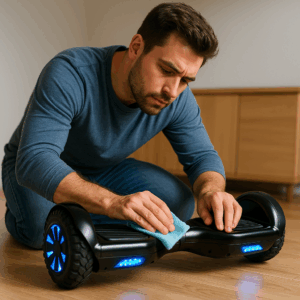
- Cleaning After Muddy Rides: If you go through mud or wet ground, take time after to clean the board. Remove any clumps of mud or debris around the wheels and underneath. This prevents long-term issues or rust. Also dry it off if it got splashed.
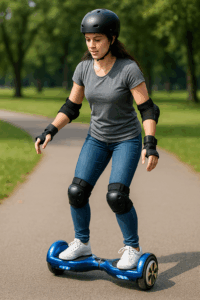
- Safety Gear: It’s worth re-emphasizing – wear that helmet, and maybe even wrist guards and knee pads if you’re doing rough trail riding. Off-road terrain can be unpredictable, and a fall on dirt can involve rocks or harder impact than a smooth floor. Gear up to protect yourself so you can keep enjoying many future rides.
- Respect the Space: When off-roading, you might encounter hikers, pets, wildlife. Keep speed moderate in such areas, pass people considerately (you might even hop off and walk the board in crowded trail sections), and don’t chase or spook animals. Tread lightly in nature.
Off-road hoverboarding adds a whole new dimension to the hoverboard hobby. It’s thrilling and practical in its own way, combining technology with outdoor recreation.
Conclusion
Off-road hoverboards bring the fun of hoverboarding to almost any terrain. With their tough tires, stronger motors, and sturdy design, they invite you to explore beyond the pavement – whether that’s carving up a dirt trail, gliding over grass, or just confidently navigating bumpy city streets.
If you have an adventurous spirit or simply want a more stable hoverboard that can handle real world conditions (where not every surface is perfectly smooth), an off-road model could be a perfect fit. They tend to be a bit more expensive than the basic models, but for many, the expanded capability and build quality justify it.
When choosing one, consider factors like wheel size (8.5” is very common and versatile), motor power, and customer reviews on durability. Some popular choices, as mentioned, include the Halo Rover X, Swagtron T6 Outlaw, Gyroor Warrior/F1/G2, and Segway’s Ninebot S-Plus (with off-road-ish ability), among otherseridehero
Ready to go off the beaten path? Just remember to ride responsibly and safely. If you’re looking for recommendations, check out our Top Hoverboard Models of 2025 – we highlight a few all-terrain options there with more detail And once you have your off-road hoverboard, the world (on and off the road) becomes your hoverboard playground. Happy exploring!

Anns is a contributor at HoverBoardRadix.com. We are committed to providing well-researched, accurate, and valuable content to our readers.